Search

Bits and Bytes

Thoughts on digital, running rambles and photos

Tag

social media

Print your own food, Yahumblr, Sharenting and this week’s bits and bytes

Print your own food: A chap called Anjan Contractor received a $125,000, 6-month NASA grant to build a prototype 3D printer that prints food. Meant for space travel, you don’t have to be a Star Trek fan to understand that it could also be used to provide food in the future when the population is higher and presumably natural food sources become scarce (HT @stangreenan and @a_little_wine).

Rather than pots, fresh ingredients, and a stove – the 3D printer creates food from basic powdered ingredients loaded in cartridges. Even better, because these cartridges contain simply the building blocks of various different kinds of food and have a massively increased shelf-life compared to fresh food, the amount of food waste would be greatly reduced.

It gets better. What’s the first dish Contractor is looking to print?

Pizza.

Source: Quartz

Yahumblr: Yahoo bought Tumblr this week for $1.1bn. Yahoo’s CEO Marissa Mayer set up her own Tumblr to announce the news – how else, but with an animated gif, the currency of the blogging platform (although, the Keep Calm meme? That’s sooo 2011). From the opening lines of her post, she is keen on making hard core Tumblrs know that Yahoo “promise not to screw it up.”

But why purchase a collection of blogs made up of cat images, animated gifs, porn (seriously, 1 in every 6 pages is NSFW) and sites dedicated to ‘Fuck yeah…’? They’re after a younger demographic and they’re hoping to sell access to it. Mayer did emphasise on an investor call that Yahoo would let Tumblr be Tumblr – but it’ll be interesting to see how Yahoo reconciles Tumblr’s naughty bits with the family friendly environment Yahoo has built up. The Harvard Business Review believes that it can work, but only if Yahoo listens closely to the Tumblr community.

Source: Marissa Mayr

Twitter security: Twitter has finally rolled out two-factor security. You link your Twitter account with your mobile phone and set it up so that you’re sent a verification message to your phone that you have to then input together with your password when you log in. That way you need the account password and your phone to log in – making it more difficult for accounts to get hacked.

The problem is that for corporate accounts that are managed by more than one person, this system won’t work because an account can only be linked to one phone number. Hopefully then, Twitter will add support for the Google Authenticator app.

Xbox One: Want to know what you’ll be getting your kids/yourself for Christmas this year? Microsoft’s new gaming console, the Xbox One.

Free McDonald’s for kidnap hero: A great bit of opportunistic PR from McDonald’s, which has decided to give the man who famously put down his Big Mac to help rescue three women held captive for years in a Cleveland house free McD’s for a year (HT @tomparker81).

A few hazelnuts short of a full spread: Imagine you’re the brand manager for Nutella. Over years, you’ve nurtured a relationship with a 40,000 strong fan community on Facebook. Every year, the page admin runs a Nutella appreciation day. A day where people share their Nutella inspired recipes and other odes to the Greatest Chocolate Spread The World Has Ever Seen (well, after Saino’s popping candy chocolate spread of course).

Happy days.

Then, unbeknownst to you, your legal department issues a cease and desist order to shut down the Nutella fan page. Obviously the fans went apoplectic, but through quick work, Nutella quickly reversed their position, wiping the chocolate from their face.

Sharenting: My social streams are full of people posting photos of their offspring. From the first ultrasound, to live tweeting the birth, Instagrammed photos of all early-life stages to jumpy six second home-video-vines of first steps and/or utterances. It bores the crap out of me. At least there’s ‘Unbaby Me‘, a handy browser extension that removes photos of babies in your Facebook and Twitter feeds and replaces them with whatever you’d rather see. I’ve gone for Imgur’s most viral RSS feed.

The Guardian looks at the pros (really?!) and cons of sharenting – the growing trend of young parents documenting their offspring’s development through social media.

Source: STFU, Parents

20 social insights: A thought provoking deck by @paulbromford about the top 20 things he learnt about social media last year. I LOVED slide #12: “Wifi is like electricity – people need it to do their jobs properly“. Then there’s #10: Trust. And #7: Relationships. Check it out for yourself – and do make sure you also visit Paul’s blog to see his notes on each slide (HT @AllThingsIC).

Tech and food: Two things I love and am ridiculously fortunate to combine in my job at Saino’s. So I was intrigued by a post from @nealunger about how similar tech and food blogging is. After all, both audiences form part of my target audience every day. Neal writes:

Both fields depend on producing large amounts of content for an obsessive and mostly financially comfortable user base. There’s a reason for the glut of well-funded tech and food web sites these days; a shitload of people read them, and advertisers want to reach that audience. To put it bluntly—tech and food publications both reach monomaniacs with money to throw around.

Tweet your afterlife away: According to the Beeb, Saudi Arabia’s religious police are employing an interesting (futile?) tactic to stop its population from using increasingly popular social media platforms to voice their political and religious views. They’re warning that anyone doing so “has lost this world and his afterlife“. They’ve obviously not heard of the Arab spring…

Social teens: Research from Pew Research Centre about teens, social media and privacy has found that teenage social media users aren’t too concerned about business or advertisers accessing their data. Do also have a look at some of the focus group quotes, as they provide an interesting snapshot of just how savvy teens are when using social media and how different platforms are used for different purposes.

Insight: Excellent advice from XKCD on adopting every new tech

Source: XKCD

Grid: Excel is a really useful program for calculations, recurring formulas and financial information. We also use it for many other purposes like content plans, weekly reports and contact lists. I’d argue that most of the things we use Excel are better done in other ways, yet it remains the go-to platform for organising information. Not much longer I hope, as this video for a new collaborative planning tool called Grid shows.

Video of the week: Clever stuff from – again! – McDonald’s with their Chalkboard versions of their menus. Such a simple idea to bring that down-to-earth, homemade and wholesome feel to a global brand.

And finally: Cat beards and of course, double cat beard.

Commander Hadfield rocks, Capcom’s Internet of you and this week’s bits and bytes

7 future comms trends: Last week @drewb spoke at CIPR Wild Wild Web about the seven future web trends that brands should know about – all with a comms slant.

AP social media guidelines: The Associated Press posted an update to their social media guidelines, looking to balance the need for speed in reporting, warning journalists to avoid spreading unconfirmed rumors through tweets and posts.

Google’s still got it: Google’s 6th annual developer conference Google I/O is happening right now in San Francisco. The main event of this 3-day-developer-marathon though was Google’s 3.5 hour keynote where they announced a whole host of new features, updates and even some new hardware. Nothing major, rather an interesting mix of new features as well as leveraging and connecting existing products in Google’s massive portfolio. My faves:

  • Google+ saw a redesign adding a new chat that syncs across all platforms and a new focus on image manipulation called ‘Image Awesome‘. No, really. Awesome. The new in-built photo gallery enhances, categorises, styles and retouches your photos. Oh, and it does this automatically.
  • Spotify, Rdio and other music streaming services will have taken note of the terribly named Google Play Music All Access. The service will cost $9.99 a month but doesn’t have an ad-supported version (yet).
  • Google Search will soon receive a makeover in terms of input: you’ll be able to just tell Google in Chrome to search for something by saying “OK, Google“. No keystrokes or clicks required. The walls are growing ears.
  • My favourite new Google feature though is the combination of Google Wallet and Gmail, allowing you to send and receive actual money to people as an email attachment. So simple, so useful.

There’s always money in the banana stand: Netflix are using the infamous banana stand from ‘Arrested Development’ to generate even more buzz around the show’s highly-anticipated return to the online streaming service on 26 May. It’s already made it to Tower Bridge and Leicester square in London!

Huggies’ Tweetpee app: Not sure if this falls into the category of ‘WTAF’ or ‘pure genius’, but Ogilvy Brazil has come up with a sensor/app combo that tells parents when their babies need a diaper change. The sensor attaches to the baby’s diaper and tweets the parent when moisture levels become too high. But, before you just leave your baby pee, Kimberly-Clark confirmed in a statement that the clip-on humidity sensor is intended merely as a concept device and will not be made available for purchase. Back to manually checking those humidity levels.

The history of Typography: Ever wonder what the hell is the difference between serif and sans serif? Why Italics were invented? No? Well, to be honest, neither did I. Still, this animated short provides a great summary of the history of typography from its invention by Gutenberg through the horror that is Comic Sans, to today’s proliferation of different typefaces in word processing software (HT @willio).

BBM on iPhone? In a move that (to me) smacks of desperation, Blackberry have announced plans to make Blackberry Messenger available on iPhone – thereby removing the last reason for actually buying a Blackberry in the first place.

The Internet of things: The idea of a future where your fridge will order another pint of milk before you run out isn’t new. In fact, Wired Magazine’s @billwasik believes the programmable world is already here, writing in his excellent essay that soon we’ll be able to choreograph them to respond to our needs, solve our problems, even save our lives.

Remember me: Take the ‘Internet of things’ idea a giant leap further into the future and you land smack bang in the world of Capcom’s new sci-fi action/adventure game ‘Remember me‘. Rather than connecting inanimate objects through the web, this futuristic dystopia (think Bladerunner) has society connecting people’s memories, sharing them instantly via the web. The internet of you, as it were.

Source: The Art of the Game


To promote the game’s central idea, Capcom partnered with Youtube videographer Devin Supertramp (famous for his clips of attractive people swinging through giant arches) and produced a clip with scenes from Devin’s very own archive of work together with a speech of Antoine Cartier-Wells, the founder the corporation in Remember who has developed the technology to connect people’s minds. Trippy, geeky – I know what’s next after Bioshock!

Here is today: An incredibly simple, yet brilliantly effective and beautiful site to tell the story of the creation of the world, the universe, everything – across all time.

Gran’s cooking: Italian photographer Gabriele Galimberti recently finished a 18-month trip around the world during which he completed a wonderful photographic project called ‘Delicatessen with love‘. A homage to grans’ cooking from around the world, the photos show portraits of grandmothers and their signature dish. The outcome is a cookery book of detailed recipes that mix love, photography and travel amongst the many exotic ingredients from Peru to the Philippines.

Source: Gabriele Galimberti

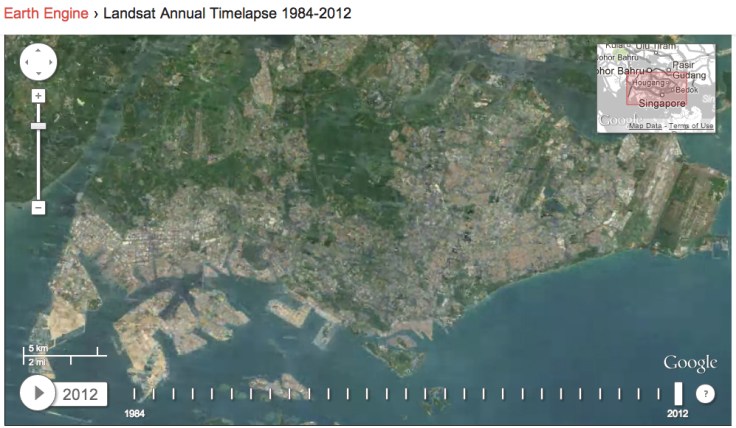
Satellite imagery time-lapse: Last week we had hyperlapse videos created using Google Maps imagery and data – this week I discovered the Google Earth Engine. Using satellite imagery from Landsat, the chaps from Google have put together a number of time-lapses spanning almost two decades from 1984 to 2012 showing everything from lakes drying out, palm-shaped islands popping up off the coast of Dubai, to the deforestation of the Amazon. Amazing and terrifying to see the often devastating effect we humans have on nature – and in such a short time.

As you’d expect from the search engine, you can also Google any other location – I found the Singaporean landgrab particularly impressive. Keep your eye on the South-Western and Eastern tips (Changi Airport) of the island.

Singapore timelapse
Source: Google Earth Engine

Video of the week: It had to be the video of International Space Station Commander Chris Hadfield singing David Bowie’s ‘Space Oddity’ while orbiting our planet. Hadfield has tweeted throughout his mission, sharing everything from Space Station sounds to stunning images of earth from outer space – but to finish it off with the first ever music video recorded in space? Well played.

Acknowledgement from the original Spaceman

I love that this gloriously ‘tached Astronaut has helped NASA land arguably their biggest PR coup since the moon landing – all by engaging the world through social media with fascinating insight into what life in space is all about, a willingness to have a conversation and a healthy dose of Canadian charm.

Here’s a little ‘best of’ compilation of Hadfield in action.

And finally: Ryan Gosling won’t eat his cereal (HT @a_little_wine).

My slides on tone of voice in social media

Yesterday I had the pleasure to speak at CorpComms Magazine’s Social Media in Action Conference at Telefonica Digital headquarters. Thank you very much to Helen for inviting me and for the other speakers and delegates for their great presentations and questions. You’ll find my slides below, they should hopefully be self explanatory – if you do have a question, do give me a shout.

Breaking news vs social media, sexy data and this week’s bits and bytes

Traditional vs. social news: There’s been a lot of discussion about how traditional media and new media failed in their coverage of the Boston Marathon bombing. I agree to a degree. CNN – and other news organisations – had a shocker and spent hours spinning a story about the bombers being identified before their identities were released by the authorities – a point that Jon Stewart (who isn’t the biggest fan of the network anyway) proceeded to make fun of on ‘The Daily Show’.

There’s also been much talk about how social media – mainly Twitter and, of all sites, Reddit – got the news wrong, as if they have some sort of obligation to get it right. That’s like accusing the patrons of your local pub of reporting the story in an inaccurate way. Social media, much like banter down the pub, isn’t subject to journalistic principles. It is bizarre to me that at times such as this people point the finger at social media and blame it for purposefully spreading misinformation. As much as technology like Twitter helps breaking news, facts, rumours and misinformation spread like wildfire, it isn’t the cause of that misinformation. The power to spread misinformation – or topple governments like during the Arab Spring – is with people, not technology.

Twitter doubles account security: While we’re on the topic of misinformation spreading on social media, this week saw yet another high profile Twitter account getting hacked. The Associated Press appeared to tweet that explosions had hit the White House and President Barack Obama had been injured. The account was immediately suspended and the tweets removed, but not before the Dow dropped about 200 points. No wonder then, that people are relieved that Twitter is finally ready to roll out two-factor authentication, a second layer of security that requires a code to either be sent to an authorised mobile device or generated via some sort of app or key-fob.

Crisis management: An interesting take on crisis management – as seen from the perspective of @jameslyne, one of the top IT security bods at Sophos. Great to see that after IT colleagues, the next team he has on the list is PR.

Interactive infographics: The aptly named ThingLink allows you to post images with extra layers of information in them such as videos and links to other supporting stories to Facebook, Twitter and many other platforms (except for WordPress it seems… grrr). Youtube videos and audio clips play in the image, text links provide a short preview and open in a new window – making for a decent user experience (at least on a desktop!). Doctors Without Borders have tried the new technology to provide an interactive guide on how they respond to crisis around the world; Cnet use it to provide a review of the new Galaxy S4; and you can check out many more ways brands and people are using ThingLink on their site. So what? you cry? Well, ThinkLink generates ‘more than five times as much engagement’ on Twitter (HT @BrionyIvy).

Data porn: Wolfram Alpha’s Facebook plugin has been live for a while and this week, the computational search engine published a fascinating dissection of Facebook data. The data provides insight into how Facebook users’ circle of friends change over time (especially in age), how their interests change as they grow older, and when their relationship status shifts from single to in a relationship to engaged to married. Now, before you go off and say, pffff, that’s just Facebook. Nobody tells the truth on Facebook – Wolfram concludes that (at least for the US) the data corresponds closely to official census data.

Source: Wolfram Alpha

Environmentally friendly suicide: “Right. Guys. We’ve got this new car. 100% water emissions. Environmentally friendly. How do we get that message across in our next ad?” Here’s how Hyundai answered this challenge (I tried to embed the video, but copies are being taken down like crazy by Hyundai). The mind boggles. Twitter wasn’t impressed. Holly Brockwell, who publishes the Copybot blog, posted a withering response to the ad, talking about how her father had committed suicide as depicted by the ad. It was quickly pulled from Hyundai’s Youtube channel but of course by then, many copies had already been made and the news spread (HT @a_little_wine).

Before you die, make sure you sort your direct debit: Your father in law passes away and you receive a bill from your cable provider telling you that as the direct debit didn’t go through – after all, the payer was deceased – you’re faced with a late payment fee of £10. What do you do? Post it to Facebook and watch it be shared over 90,000 times! All ends well though, Virgin Media apologised, the late payment charge was removed and the customer wrote a poem to celebrate (HT @KristianWard29).

Feed the troll until it bursts: The general consensus on social is to not feed the trolls. They’re bored, looking for a fight, to get a rise out of you, to see if they can get you to breaking point. Well, whoever manages the @Cineworld Twitter feed is the exception that proves the rule. Seriously, worth reading the entire exchange – if you have a bit of spare time! @Lakey from econsultancy takes a closer look at the exchange and why not more companies handle customers this way.

Location based recommendation: Foursquare continues its shift from check-in to a search an discovery space. Turns out that over 50 million people have visited its homepage in the last two months.

Videos of the week: the dancing babies are back

New LG screens are just too darned realistic

And some buttery goodness from Lurpak.

And finally: After Bayern and Dortmund demolished their hapless opposition in the Champions League semifinals, Paddy Power posted this wonderful photo to their Facebook page. And yes. That is The Hoff.

#NowThatchersDead, monetising spam and this week’s bits and bytes

Twitter and the death of Baroness Thatcher: Wall to wall coverage, equal parts mourning and vitriol, and many, many tweets. The hashtag #nowthatchersdead started trending shortly after the news was announced – some people misread that as ‘now that Cher is dead’. An Oddbins manager tweeted that Taittinger was on offer for £10, down from the usual £29 – the message was quickly condemned as ‘shameless’ and ‘sick’ and the manager suspended. The Met Seargeant who tweeted that he hoped Thatcher’s death was ‘painful and degrading’ resigned a few days later. And then there’s Ding Dong, the With is Dead. There’s more and the Beeb has a great post on how the news was reported online.

Was it really such a surprise though? Nope.

Is the vitriol a neat summary of everything that’s wrong with Twitter? Absolutely not.

People have their opinions – with or without Twitter. The fact that any comments you make on the Internet without first activating your brain can (and will) come back to bite you is something that should be a part of media literacy courses in school. Perhaps that would have saved Paris Brown’s job as Yout Crime Commissioner?

Is the scoop dead? That is the question @Marcousleroux and @Steve_Hawkes discussed after a comment from Kevin Ryan, co-founder of Business Insider:

Marcous argues that market forces are driving people away from news gathering, while Steve believes Twitter and scoops, more than ever, are a must. Here’s the full thread (HT to @antsilverman).

Retail geekery: A bakery in Tokyo has implemented a new scanning system that scans food by recognising the shape and colour of each item, no need for a barcode or human assistance, while New Balance launches Its Own 3D-Printed Shoes. Still on 3D-Printing, our very own Rob Fraser recently spoke about 3D printing saying that we have to prepare for the fact that consumers may soon not want to buy pre-packaged iPhone cases, but build and design their own. This lovely little animated clip from GrafixTV shows how 3D printing is changing retail:

http://youtu.be/NiOKDOnJ3VE 

Facebook looking to monetise spam: Would you pay $15 to direct message Justin Bieber on Facebook? I wouldn’t, but that’s what Facebook are looking to do in the UK. The prices are staggered at $1, $10 and $15 (depending on how popular the person that you’re looking to message is) and Facebook say that it is an attempt to cut down on spam. Looks like a brilliant way to monetise millions of terabytes worth of Belieber spam. I wonder how long until artist management bods demand their cut.

Facebook Home: Facebook are serious about their new immersive mobile experience. They moved quickly to address the privacy concerns about having your entire private life display on your home screen on their newsroom blog (if you don’t want Home to appear as your lock screen, you have the option to turn that off) and they’ve launched their first ever TV ad. But is it going to be enough to get kids excited about Facebook again?

Social media investor relations: a great post from Edelman on what the SEC rule on disclosure in social media means for IR.

Crowdsourcing products: Nissan is using its social channels to allow fans to help customise and name a one-off version of the Juke Nismo. At Saino’s, we’ve crowdsourced feedback on our 20×20 sustainability plan with Green Mondays and our 20×20 event last year. We’ve also asked our fans what cookie flavour they’d like to see in store and put the results to a vote.

Source: Sainsbury’s Facebook page

Econsultancy looks at what other brands are crowdsourcing.

InstaAds are here: The Internet was up in arms when Facebook bought Instagram for $1bn because it though all photos would now be used in and as ads against their will. It’s been six months and the InstaAds haven’t materialised. Obviously, things aren’t moving fast enough for brands because they are advertising on Instagram – and neither Instagram nor Facebook are seeing a single dollar for it. Unilever and Pepsi have teamed up with celebs such as Beyonce and Nicole Richie (OK, ‘celebs’ might be stretching it a bit) for sponsored posts.

Video of the week: Dove hair care for men

and Samsung test their new washing machine in the extreme of conditions – with unexpected results.

And finallyVinetune.com

Facebook Home, pizza box art and this week’s bits and bytes

It’s that time of the month where I compile some of our favourite tweets of the month. This edition contains a hilarious dose of Comic Relief goodness from our colleagues around the country, featuring everything from a gorilla in a mankini to a life-size T-Rex chomping its way through the South of England.

Facebook Home: Facebook is doing exactly what they said they wouldn’t do, launch a phone. Well kind of. Only not. It’s called Facebook Home and changes your phone into one giant Facebook app (I’m most freaked out by your phone’s lock screen becomes a direct link to your Facebook profile, messages and notifications. Privacy?). Facebook Home will come pre-installed on the ‘HTC First’ or you can convert your existing Android handset into a “Facebook Phone” by downloading the new software on 12 April. Unsurprisingly, the people at Twitter weren’t impressed.

Source: Mashable

Classy Brits: Class was the big story this week (isn’t it always?) with the BBC publishing the The Great British Class Calculator. No longer are there just three classes (upper, middle and lower), we now have seven; ranging from ‘elite’ to ‘precariat’. My favourite though has to be ’emergent service workers’, possibly the best euphemism for ‘hipster’ I have ever heard.

Now that’s one pissed off journalist: There is something poetic about beautifully phrased foul language. The Indie’s Tom Peck has provided a cracker.

Social media investor relations: The US Securities and Exchange Commission (SEC) this week unveiled new rules that allow companies to to make key announcements via Facebook and Twitter – only if shareholders have been alerted beforehand about which social-media outlet they should turn to (as to how shareholders are alerted, the SEC doesn’t say – suppose I wouldn’t be surprised to see @CompanyNameIR accounts popping up soon).

Blogs more influential than Twitter: An interesting post from The Wall Blog (who I suppose would agree) that blogs drive sales more than other forms of social media. Confirmation comes in the Technocrati 2013 digital influence report, that sees blogs come out ahead of Facebook, Youtube, Google+ and Twitter.

Facebook get’s in line: Great news if you provide customer service through Facebook. The big blue social network is launching in line replies on posts, allowing community managers to respond directly to questions. This will of course also make any type of topical interaction such as live Q&A much easier to manage on Facebook, so customer service and social media managers around the world should welcome this with open arms.

Sketchy customer service: Fast food deliveries that come in a cardboard box provide a great canvas and opportunity for fulfilling the demands of your customers. A splendid gallery of pizza box art at the behest of customers from around the world in this gallery.

Source: takeaway.com

Twitter for business: Twitter launched a page chock full of case studies from companies on how they use the micro-blogging service to meet their business objectives – hoping (I suppose) that you’ll end up using their services and tools and spend more money.

Faking it on Twitter: Faking a tweet isn’t the most difficult thing to do. Take a screenshot of an existing tweet from an account you’d like to spoof, modify it in your image editing software of choice, post it to t’interwebs as ‘check out what so-and-so said’ as a screenshot, adding that they’ve since removed the tweet (t’interwebs loves a cover-up!). However, this requires a basic level of image manipulation skills and a bit of effort – until now, with a new web-based software that allows you to fake tweets in a few clicks. Brian Solis looks at why this is a dangerous situation, one that I imagine Twitter can’t be too happy with!

Video of the week: Arthur C. Clarke completely predicts the Internet. In 1974.

Some of my favourite April Fool’s stories from this past week: with its Guardian Goggles video, the Guardian showed that they not only know exactly who their readers are, but that they also have enough of a sense of humour to poke fun at themselves.Meanwhile, Google went slightly OTT with their pranks – here are just three of them: Youtube announced that after eight years, they were shutting down the site to give the 30,000 strong jury until 2023 to announce the best video ever. Google Maps got a treasure hunt upgrade to find Captain Kidd’s treasure. Finally – a way to plug in your olfactory senses into Google search and find that smell you were always looking for. Or, to put it simply: Smell-o-vision! I’d argue though, that The Metro did the best with their made up April Fool round-up. Very meta.

Workplace etiquette in poster form: a beautifully designed set of posters for today’s office population. My favourite: “Respect headphones as a sign of intentional isolation”.

Mad Men Season 6: The penultimate season starts with a double episode in the US on Sunday, coming to Sky Atlantic in the UK on April 10th. To get in the mood I am rewatching season 5 and enjoying this post on Business Insider about how SCDP’s ads compared with the actual ads that ran in the 1960s. And yes. I am hyperventilating.

And finally: three new memes popping up over the last few weeks that are looking to take on the mantle of ‘the new planking’. First, we have Pottering. The trend looks to have kicked off in Oz and there’s a Pottering Facebook page with some quality efforts. I have to admit though, I’m quite fond of Vadering – something that has already made it into The Sun and The Metro. My favourite though has got to be Hadouken. Anyone with a mispent youth playing ‘Street Fighter’ will know the move and the precise flick of the wrist required to generate that devastating fireball will recognise these poses.

Source: The Tech Journal

Flipboard 2.0, collaborative marketing and this week’s bits and bytes

Back from hiking the Grand Canyon – more on the actual hikes in the next few days when I’ve digested the Garmin data. What I found out since coming back: Google has mapped the Canyon and you can enjoy the views from the comfort of your couch. I’d rather enjoy them first hand, but here’s how they did it.

Sainsbury’s on Flipboard: this week, the super-slick content aggregator Flipboard announced their 2.0 version. The big news being that you can now curate your own magazine. Excited to try it out, I quickly put together a Flipboard Magazine about Sainsbury’s. Let me know what you think and if you’re on Flipboard – subscribe! You can find out what’s else is new with Flipboard 2.0 in this video.

Budget screw up: The following is from @tomparker81: During last week’s budget announcement, the Evening Standard tweeted its front page about 20 minutes before the Chancellor had even stood up, thus giving away all of the detail in the Budget. Bit of a screw up really and someone at The Standard has been suspended for it.

Damian McBride, former chief spinner to Gordon Brown, has written a really interesting blog post about it which should be of interest to anyone doing our job. It describes how you brief a paper like the Standard to get them in just about the right place but without enough detail to give too much away.

Paywalls vs. free: The Telegraph and then The Sun announced they’d be moving to a metered model where readers would be able to read 20 articles a month for free before having to pay for access to the online paper. Meanwhile, the DMG Media, presented their latest financials: the MailOnline is set to make £45 million in 2013 and that that figure will reach £100 million in the next three to five years.

Brands can learn from newsrooms: How can a brand keep up conversations that are fresh, relevant and interesting? Our friends at Dare thinks we should learn from the Newsrooms, think like journalists and keep asking those important W-questions.

Bots artificially inflate site stats: brands such as McDonalds and Disney paid millions of dollars a month to show their online ads to websites that had their traffic numbers artifically inflated by automated networks of computers (aka bots). Spider, a London based analytics firm, found that sites such as toothbrushing.net, sodabottle.com and techrockstar.com were showing 20 to 20 million ads in a month – and that these sites were all linked to a network of botscalled Chameleon. Can’t imagine the marketing teams were very happy…

Tracking Facebook: Still on metrics, a quick and sensible guide to what you should be tracking on Facebook.

Remember the Harlem Shake? Only a few weeks ago, the Harlem Shake seemed to be everywhere. It exploded out of nowhere, annoyed the crap out of the Internet for a good two weeks and has since disappeared (if nothing else, please read the ‘What has changed‘ paragraph)

Social chocolate: A case study of how Cadbury does social.

Fashion rules Instagram: a quantitative look at the top 25 brands on Instagram shows quite clearly that fashion brands have embraced the hipsters’ image sharing network of choice. Victoria ‘s Secret (unsurprisingly?) tops the list with over 1.3 million followers. Other fashion staples in the top 25 include Nike, Forever21, Burberry, Top Shop, asos, H&M, Adidas and Gucci. Playboy (surprisingly?) comes in at no.20.

Collaborative marketing: social media, digital, web 2.0 – call it what you want, it is changing the way brands communicate. Simply put, customers want a meaningful conversation and the stage is set for social tech to begin creating real value for companies through deep collaboration with consumers. Fast Company has listed 5 trends driving the shift.

Videos of the week: Remember the flick ‘Catch me if you can’? Spielberg based the film on the true story of Frank Abagnale and in a speech at Adweek, Abagnale talks about how, as a runaway 16-year-old he spent two years defrauding Airlines of 1.3 million dollars, constantly shifting his identity. Without glorifying his actions, he talks about how he did it and how he was caught. After serving time in France, Sweden and the US, the FBI offered him a role in their fraud division. In the Q&A at the end, he provides some fascinating insight into how you can protect your privacy, from when you’re on Facebook to when you’re paying for petrol. Absolute must watch (HT @JoTomlin).

‘Grumpy Cat’ stars in Friskies Youtube campaign.

And finally: a headline and story so chock full of WTF? you just know that it has to be true http://avc.lu/1097xcB (HT @tomparker81).

Happy Easter everyone!

4SQ is back, we have a new Pope and this week’s bits and bytes

Digital UK: We are Social have pulled together a very useful state of the digital nation from the 2013 UK Digital Future in Focus report published by comScore. Loved the tweetable highlights:

  • As of December 2012, we’re at over 50% mobile penetration in all EU countries
  • We spend 37 hours a month online in the UK – more than any other country
  • Online shopping reaches 9 out of 10 UK Internet users
  • 1 in 5 of us use their mobile to shop

Screen Shot 2013-03-15 at 20.41.18

Foursquare is about maps and data – not badges and mayorships: I’ve not been the biggest fan of the location based social network Foursquare – seems like I’ve missed the point! Founder Dennis Crowley was at SXSW this week to talk about the future of location and the shift from social network to utility. I’ve only been able to read the @JeremyWaite‘s Storify of the talk, but that has provided some fascinating insight. For example, using Foursquare data, you could see what people in New York were up to during Hurricane Sandy or you can map all the checkins on Foursquare across the entire globe over the last three months – there’s 500 million of them, so you have a pretty robust dataset. Go on, zoom in to London. You can clearly identify roads, even Hyde Park and Heathrow are easily identifiable. As for data, think about it like this: Foursquare can tell you who the most influential customers (on social media) are that visit your stores.

The thing I’m taking away from the talk though is this pithy summary of what Foursquare is: Foursquare is a local search engine. It was about the merit system – something I don’t think really ever caught on – In 2009. Today they’re are phasing out the gamification and focusing on local data, maps and recommendations.

Just to finish on SXSW, the guys at Edelman Digital published a handful of their SXSW observations from the annual gathering. A good, quick overview.

http://twitter.com/Pontifex/statuses/311922995633455104

Habemus Papam Franciscum: Gotta hand it to the Catholics, they sure know how to run a press event. For three days the world’s media watched a chimney and compared many old men who they knew little about. Meanwhile, millions of people had the their fingers and pope puns ready to tweet. Finally, when white smoke did billow from the chimney, seven million tweets welcomed Pope Francis and his first tweet has already been retweeted over 80,000 times – my particular favourite tweet was from a guy wasn’t too chuffed with the announcement.

While we’re on the topic, a cheeky look at what PR folks can learn from the Vatican and the 10 social media business commandments. As cheesy as it sounds, these are actually quite good!

Facebook is no longer cool: Last week I talked about Facebook, their new Newsfeed design and what will chance. This week Buzzfeed added to a growing list of articles from a variety of publications that talk about how Facebook is slowly losing it’s cool. Essentially, Buzzfeed argues that Facebook has been so focused on creating an environment conducive to apps, it has left users and their personal needs by the wayside.

You are what you like: Facebook users are unwittingly revealing intimate secrets – including their sexual orientation, drug use and political beliefs – using only public “like” updates, according to a study of online privacy by Cambridge University.

‘Liked’ hospitals have a lower mortality rate: A new study published in The American Journal of Medical Quality points analyzed the 30-day mortality rates across 40 New York hospitals and cross-referenced their Facebook page like. They found that the more ‘likes’ a hospital had, the lower its mortality rates.

Booze brands on social: Trade mag The Drinks Business has a great summary of the top 10 alcohol brands that are ruling social media, how they rank and what they’re up to (HT @a_little_wine).

Videos of the week: During this year’s London Fashion Week, Topshop partnered with Google+ to provide an immersive experience for fans. More about how they did it on Diffusion.

A phone call in the middle of the night: your best friend is in trouble. Would you go out and help him? Carlsberg tests some friendships.

And finallyInstagramed art on plates (don’t worry, no hipsters in sight).

How things go viral, Bieber fury, your new Facebook and this week’s bits and bytes

Horse meat on social: The guys over at Digimind have pulled together a great little infographic of how the horse meat story has developed on social since it broke in mid January. As a Sainsbury’s colleague, I am of course proud to see that our name has rarely been connected to the issue.

Gorkana really doesn’t like AVEs: they’ve published 16 reasons why AVEs don’t measure PR. Solid stuff.

How does stuff go viral? A marvellous feature by Al Jazeera’s The Stream about how videos like Gangnam Style and Harlem Shake go viral. It’s a half hour clip, so sort out a cuppa and get comfy before you get started (as an aside: just check out how the 30 minutes brings together broadcast, Google+ and Google Hangout, Twitter, Skype… very cool).

Misogynistic algorithm screws Amazon: Last weekend, Amazon got itself in a spot of bother when it was found to be selling thoseoh-so-hip ‘Keep Calm and…’ t-shirts. Not only are they entirely naff, these particular ones were emblazoned with charming sentiments such as ‘Keep Calm and Knife Her’ or ‘Keep Calm and Rape a lot’. The shirts were being sold through Amazon by a third party company called Solid Gold Bomb and were quickly removed after the online retailer received a barrage of tweets and complaints. Solid Gold Bomb quickly apologised. How could this happen? Well, turns computer algorithms rather than people that generate different versions of the ‘Keep calm…” slogan automatically and prints them onto shirts when somebody clicks on buy on Amazon. I suspect they will be coding a misogyny filter very soon…

Belieber fury: so, like, OMG, Justin totally showed up late to his gig because he thought he’d, like, be all rock and roll and stuff. While I’m working on how I can get a refund on my TV license fee after the BBC spent two days reporting on the total non-story of Bieber pissing off little girls (and their parents), have a look at this brilliant piece of opportunistic advertising by GetTaxi who sent a cab to Bieber’s hotel to make sure he’d at least be on time for his remaining three O2 gigs (HT ‏@GoodandBadPR).

Also, the best ever photo of a dad at a Justin Bieber concert (HT @Pandamoanimum)

Murdoch blogging: well, technically, his chief of staff Natalie Ravitz, who posts updates of the media mogul’s activities. From shooting clay pigeons, to checking out CES, to shearing a sheep – running an empire is hard work.

How Search Works: Google has launched a new interactive website giving you a look at what goes on behind the scenes everytime you Google something: how it crawls the web and indexes over 30 TRILLION pages, its alogrithms and ranking strategy, and how it fights and removes spam.

New Facebook Newsfeed: Facebook have announced a new design for their newsfeed. It will be met with millions of people complaining about how crap the new design is and how much they want the old layout back. Petitions will be created. #iwantmyfacebookback will start trending. Fast forward 12 months and it will all happen all over again. But what’s new?

  • the new design will look exactly the same no matter which device they use to access their feed
  • videos and images will now be offered more space and prominence
  • the new newsfeed will allow many more options to filter content; including, just stuff from friends, close friends, or according to different media types (photos, music), and also – finally – ALL posts, regardless of their Edgerank (for those that like to believe they are in control of their feed).

Why do this? Friendly Facebook people tell you why in this video.

Videos of the week: the best celebrity interview the world has ever seen features the wonderful Mila Kunis and a star struck and underprepared yet entirely charming interviewer from BBC1;

The Onion questions if you’re dynamic enough to work in a marketing firm; and then there’s Jamie Oliver’s Food Tube interactive video where not only can you smack Jimbo, you can even make him shove a chilli down his pants (HT @susieod).

And finally: Go to www.gizoogle.com. Enter your Twitter handle, the URL of your favourite website, or just do a web search. I searched for Sainsbury’s. I’ve not stopped giggling (HT @TomParker81).

Blog at WordPress.com.

Up ↑